
Here’s a brutal fact:
Most battery packs fail long before they ever reach the customer — not because the cells are faulty, but because the battery pack assembly process was rushed or poorly managed.
From a distance, battery pack integration may seem like a straightforward progression: design the PCBA, install the cells, wire it up, close the enclosure. In reality, every step between PCBA and final assembly is a minefield. Tolerances, thermal management, BMS communication, cell matching, interconnects, mechanical housing, and test protocols — it all has to come together perfectly. Miss one piece, and you’re looking at field failures, safety recalls, or a product that simply can’t scale.
At Karkhana.io, we work with customers across the EV, energy storage, IoT, and industrial automation space who are scaling battery-powered products through structured battery pack assembly services. What we’ve consistently seen is this: integration is where good designs go to die — or where they finally become market-ready. Let’s break down the biggest challenges in this critical phase and how to overcome them.
1. Mismatch Between PCBA and Mechanical Housing
A frequent pain point we encounter is a disconnect between the electronics and mechanical teams. The PCBA is designed without full consideration of how it will be mounted, connected, or cooled inside the pack. The result? Last-minute redesigns or awkward workarounds that increase failure rates.
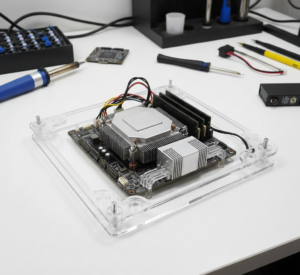
Common issues include:
- PCBA doesn’t align with cell interconnects or busbars
- Heat sinks don’t match thermal interface material placement
- BMS connectors are blocked or too short for assembly
- Enclosure design doesn’t allow for serviceability
How we help:
Our approach at Karkhana.io involves early-stage DFM and cross-functional design review. Our turnkey capabilities allow us to test PCBA integration directly with enclosures and thermal assemblies before full production, reducing surprises on the shop floor.
2. Cell Interconnect Complexity
Cells don’t just need to be connected — they need to be matched, balanced, and safely joined. Inconsistent weld quality, poor material choices, or design inflexibility in cell tabs can all derail a pack during the battery module assembly process.
Challenges include:
- Weld spatter damaging nearby components
- Inconsistent resistance in interconnects leading to imbalance
- Rigid busbar designs that don’t tolerate manufacturing variation
- Incompatibility between interconnect layout and BMS sensing
Our solution:
We validate busbar and interconnect design using mock-ups and pilot assemblies. We also support cell tab customization through our vetted supplier network, ensuring high repeatability and low contact resistance — critical for long-term reliability and thermal performance.
3. Thermal Management Missteps
You can have the best cell chemistry and BMS in the world — but if your pack runs too hot, performance tanks and failure risks skyrocket. Yet, thermal considerations are often handled reactively, rather than as a core part of integration.
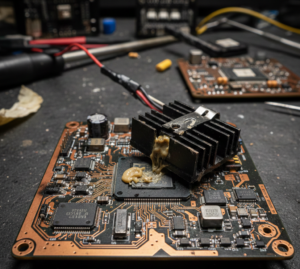
Warning signs:
- Passive cooling assumed without load testing
- Heat sink contact gaps due to poor tolerance stacking
- Incomplete integration of thermal interface materials (TIMs)
- Conformal coating on PCBA interfering with heat flow
What we do differently:
Karkhana.io supports thermal simulation reviews and prototype builds with real-world heat load testing. We also help customers source and apply appropriate TIMs, potting compounds, or active cooling mechanisms depending on use-case and production scale.
4. BMS Integration and Firmware Testing
The Battery Management System (BMS) is the brain of your pack. But even if your firmware is solid, integration challenges can derail communication, monitoring, and protection functions.
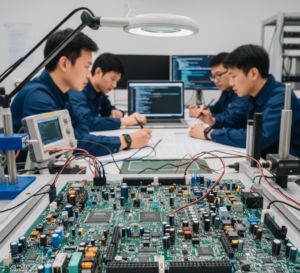
Integration issues include:
- Noise or interference in communication lines (CAN, SMBus)
- Inaccurate cell voltage readings due to bad routing or poor solder joints
- Unaccounted resistance in sense lines or balancing circuits
- In-field firmware updates being impossible post-assembly
Karkhana.io advantage:
With our in-house SMT and through-hole lines, we not only assemble PCBs with high-precision soldering and X-ray inspection, but also run firmware flashing and board-level testing before integration. We ensure the PCBA is ready before it meets the cells.
5. Final Assembly Tolerances and Workflows
Even with all components in place, final assembly is often underestimated. Clamping, routing, wire dressing, potting, screw torque control — these are the invisible processes that define pack reliability.
Risks we often flag:
- Crushed components or wiring due to tight fits
- Manual wiring inconsistencies leading to poor contact
- Voids in potting due to rushed filling
- Connector misalignment due to cumulative tolerance errors
How we handle it:
Karkhana.io provides complete box build services — not just PCBA. Our team oversees jig-based assembly workflows, real-time process validation, and visual inspections. From the first build to scaled production, we ensure every step is documented, repeatable, and optimized for speed and reliability.
6. Testing Protocols That Actually Work
If you’re not testing your pack as a complete system — under real conditions — you’re not really testing it. Yet, many manufacturers stop at continuity checks or basic open-circuit voltage readings.
Effective testing includes:
- Functional testing of BMS under simulated load
- Pre-conditioning and thermal cycling
- Leak and ingress tests for enclosures (IP rating verification)
- Logging communication behavior over multiple charge/discharge cycles
Our test approach:
We offer in-line and end-of-line test stations tailored to the battery pack’s configuration. With data logging and pass/fail tracking, our testing isn’t just for compliance — it’s for learning and improving.
Final Thoughts: Integration Isn’t Just Assembly — It’s Engineering
Battery pack integration is where the risks pile up — and the hidden costs hide. The final product isn’t just about connecting parts; it’s about orchestrating a system that performs safely, reliably, and at scale.
At Karkhana.io, we’ve built a turnkey ecosystem to help customers move from PCBA to final pack with fewer unknowns and a lot more confidence. With over 1,00,000 sq. ft. of manufacturing space, 7 SMT lines, dedicated box build capacity, and advanced inspection systems, we don’t just assemble — we engineer integration.
Whether you’re building packs for two-wheelers, energy storage, consumer electronics, or industrial tools, we help you navigate the last mile of product development — without overengineering it, without cutting corners.
Let’s build battery packs that perform as intended — the first time, every time!