
Sheet metal fabrication is an integral process in modern manufacturing, used to produce components for industries ranging from aerospace to electronics. However, like any engineering process, it’s prone to defects in sheet metal. Issues such as burrs, cracks, and warping can compromise product quality, cause delays, and escalate costs.
Sheet metal fabrication is an integral process in modern manufacturing, used to produce components for industries ranging from aerospace to electronics. However, like any engineering process, it’s prone to defects in sheet metal. Issues such as burrs, cracks, and warping can compromise product quality, cause delays, and escalate costs.
If you’ve ever faced challenges in achieving precision or maintaining surface integrity, this detailed guide is for you. Let’s uncover what it takes to make sheet metal processes defect-free and efficient.
1. Cutting Defects: Burrs, Rough Edges, and Warping
Defects and Causes
- Burrs: Unwanted raised material along the cut edges, often caused by dull cutting tools or excessive clearance.
- Rough Edges: Irregularities resulting from improper feed rates or tool misalignment.
- Warping: Deformation due to thermal stress during laser or plasma cutting.
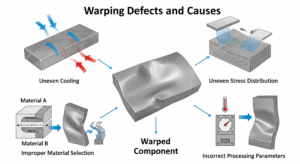
Solutions
- Ensure tool sharpness and proper clearance settings during shearing.
- Optimize laser or plasma cutter settings—adjust power, speed, and focus based on material thickness.
- Use waterjet cutting for heat-sensitive applications to eliminate thermal distortion.
2. Bending Defects: Springback, Wrinkling, and Cracking
Defects and Causes
- Springback: The elastic recovery of metal after bending, leading to inaccurate angles.
- Wrinkling: Excessive compression on the inner bend radius due to inadequate die design or force application.
- Cracking: Fractures along the outer bend radius caused by insufficient material ductility or a sharp bend radius.
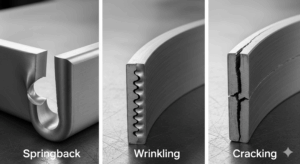
Solutions
- Compensate for springback by applying overbending techniques or selecting materials with lower elasticity.
- Reduce wrinkling by using tighter die clearances and ensuring proper support during bending.
- Prevent cracking by maintaining a minimum bend radius—ideally 1.5x the material thickness.
3. Welding Defects: Porosity, Cracks, and Spatter
Defects and Causes
- Porosity: Gas entrapment during the welding process, often due to surface contamination or improper shielding gas.
- Cracks: Structural failures caused by thermal stresses or incompatible filler materials.
- Spatter: Molten droplets formed by excessive heat or incorrect welding parameters.
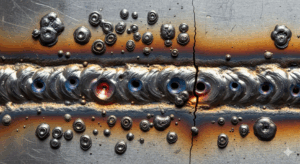
Solutions
- Ensure surfaces are clean and properly prepared before welding.
- Use appropriate filler materials and preheat to minimize thermal stresses.
- Optimize welding parameters, including current, voltage, and travel speed, to reduce spatter formation.
4. Stamping Defects: Cracks, Wrinkles, and Tool Marks
Defects and Causes
- Cracks: Material failure during high-force stamping operations.
- Wrinkles: Surface distortions on deep-drawn or stretched components due to improper blank holding.
- Tool Marks: Scratches or indentations from worn or misaligned dies.
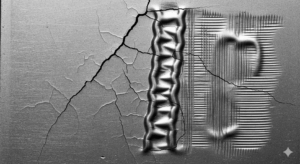
Solutions
- Choose high-ductility materials for complex stamping operations.
- Use blank holders to control material flow and prevent wrinkling.
- Regularly inspect and maintain tools to eliminate marks and ensure consistent performance.
5. Surface Defects: Scratches, Dents, and Corrosion
Defects and Causes
- Scratches/Dents: Mechanical damage during material handling or fabrication.
- Corrosion: Oxidation or chemical reaction due to improper storage or surface finishing.
Solutions
- Implement protective handling protocols such as using soft padding or films during transport.
- Apply protective coatings like galvanization, anodizing, or powder coating to enhance corrosion resistance.
6. Forming Defects: Thinning and Splitting
Defects and Causes
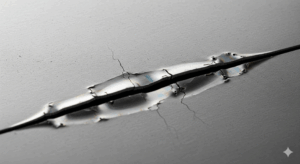
- Thinning: Uneven material thickness due to excessive stretching in forming operations. This leads to thinning defects in sheet metal fabrication.
- Splitting: Fractures that occur when tensile stress exceeds material limits.
Solutions
- Use materials with consistent thickness and higher ductility for forming operations.
- Optimize process parameters, such as drawing speed and punch design, to achieve uniform material flow.
-
Apply preventive techniques to prevent metal forming false tripping, ensuring smoother operations.
Preventing Defects: General Best Practices
- Material Selection: Use materials with properties suitable for the specific process, such as ductility and tensile strength.
- Tool Maintenance: Regularly inspect and replace worn tools to ensure accuracy.
- Process Optimization: Calibrate machinery and use advanced technologies like CAD simulations to predict and prevent defects.
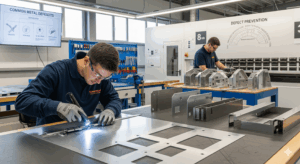
- Quality Control: Implement strict inspection protocols at each stage of the process.
Sheet metal fabrication is a cornerstone of modern manufacturing, but it’s not without its challenges. Defects like burrs, cracks, warping, and more can disrupt production, increase costs, and compromise quality. Addressing these issues requires a deep understanding of material properties, precise control over processes, and a commitment to continuous improvement.
This is where Karkhana.io steps in as a trusted manufacturing partner. With a network of vetted suppliers and expertise across fabrication processes, Karkhana.io provides tailored solutions to help you overcome common defects and achieve flawless results. From sourcing high-quality materials to ensuring precise tolerances and delivering on-time, Karkhana.io simplifies the complexities of sheet metal fabrication for businesses of all sizes.
By leveraging our robust processes and engineering expertise, manufacturers can eliminate costly rework, enhance productivity, and maintain the highest standards of quality. Whether you’re dealing with small batch production or scaling up for large-volume manufacturing, Karkhana.io is your one-stop solution for defect-free, efficient manufacturing.
Ready to take your sheet metal fabrication to the next level? Let’s collaborate to build better, faster, and smarter. Contact us today to get started!
Frequently Asked Questions:
Q1. What are the most common defects in sheet metal fabrication?
The most common defects in sheet metal include burrs, cracks, wrinkles, thinning, warping, and corrosion, caused by tool wear, poor material choice, or improper process control.
Q2. How do thinning defects in sheet metal occur?
Thinning defects in sheet metal happen when excessive stretching during forming reduces thickness unevenly. Optimizing punch design and material ductility can minimize this issue.
Q3. What are sheet metal stamping defects and how can they be avoided?
Sheet metal stamping defects include cracks, wrinkles, and tool marks. They can be prevented by using high-ductility materials, proper blank holders, and regular die maintenance.
Q4. Why does a wrinkle defect in sheet metal bending occur?
wrinkle defect in sheet metal arises due to inadequate die design, compression, or poor blank holding. Adjusting die clearance and applying correct force reduces wrinkling.
Q5. How can manufacturers prevent metal forming false tripping?
To prevent metal forming false tripping, manufacturers should calibrate machines, monitor process parameters closely, and use advanced simulation tools to detect errors before production.